Solar Weather & HF Propagation
Today's Propagation Score
100 / 100Excellent
Outstanding propagation conditions. Higher bands (10-17m) should be excellent for DX. All bands performing well.
Conditions are stable with no major positive or negative influences.
How This Score Was Calculated
Starting from a base score of 100, adjustments are made based on current space weather conditions:
| Metric | Current Value | Points | Impact |
|---|---|---|---|
| Kp Index (Geomagnetic Activity) | 2.3 |
0 | Geomagnetic conditions are quiet |
| Bz (Interplanetary Magnetic Field) | -1.0 nT |
0 | Bz is near neutral |
| Solar Wind Speed | 434 km/s |
0 | Solar wind speed is nominal |
| X-Ray Flux (Solar Flares) | B3.6 |
0 | Background X-ray levels (A/B class) |
| Solar Flux Index (SFI) | 100 |
0 | Moderate SFI provides baseline ionization |
| Final Score | 100 | Excellent | |
Current Values vs. Reference Ranges
See where today's values fall within the typical range for each metric. The marker shows the current reading.
Kp
SFI
X-Ray
Wind
Bz
Spectrum Impact Overview
Visual representation of current space weather effects across the radio spectrum.
Ham Band Propagation Report
Status Meanings:
- Open - Band is propagating well; DX likely
- Mostly Open - Good conditions with occasional fading
- Variable - Mixed conditions; some paths open
- Mostly Closed - Limited propagation; local/regional only
- Closed - No F-layer skip; groundwave only
Confidence Levels:
- High - Prediction based on multiple reliable indicators
- Medium - Good confidence but conditions may vary
- Low - Limited data; treat as estimate only
HF Bands (1.8 - 30 MHz)
| Band | Frequency | Status | Confidence | Rationale |
|---|---|---|---|---|
| 2200m | 135.7-137.8 kHz | Open | Medium (70 %) |
|
| 630m | 472-479 kHz | Open | Medium (70 %) |
|
| 160m | 1.8-2.0 MHz | Open | Medium (70 %) |
|
| 80m | 3.5-4.0 MHz | Open | Medium (70 %) |
|
| 60m | 5.3305-5.4035 MHz | Open | Medium (70 %) |
|
| 40m | 7.0-7.3 MHz | Open | Medium (70 %) |
|
| 30m | 10.1-10.15 MHz | Open | Medium (70 %) |
|
| 20m | 14.0-14.35 MHz | Open | Medium (70 %) |
|
| 17m | 18.068-18.168 MHz | Open | Medium (70 %) |
|
| 15m | 21.0-21.45 MHz | Open | Medium (70 %) |
|
| 12m | 24.89-24.99 MHz | Variable | Medium (70 %) |
|
| 10m | 28.0-29.7 MHz | Variable | Medium (70 %) |
|
VHF Bands (50 - 225 MHz)
| Band | Frequency | Status | Confidence | Rationale |
|---|---|---|---|---|
| 6m | 50-54 MHz | Variable | Medium |
|
| 2m | 144-148 MHz | Open | Medium |
|
| 1.25m (220) | 222-225 MHz | Open | Medium |
|
UHF & Microwave Bands (420 MHz+)
| Band | Frequency | Status | Notes |
|---|---|---|---|
| 70cm | 420-450 MHz | Open | UHF primarily line-of-sight; minimal ionospheric impact |
| 33cm | 902-928 MHz | Open | UHF primarily line-of-sight; minimal ionospheric impact |
| 23cm | 1240-1300 MHz | Open | UHF primarily line-of-sight; minimal ionospheric impact |
| 13cm | 2300-2450 MHz | Open | Microwave bands rely on tropospheric propagation; Weather and atmospheric conditions more relevant than solar |
| 9cm | 3300-3500 MHz | Open | Microwave bands rely on tropospheric propagation; Weather and atmospheric conditions more relevant than solar |
| 5cm | 5650-5925 MHz | Open | Microwave bands rely on tropospheric propagation; Weather and atmospheric conditions more relevant than solar |
| 3cm | 10.0-10.5 GHz | Open | Microwave bands rely on tropospheric propagation; Weather and atmospheric conditions more relevant than solar |
Tropospheric Propagation Conditions (VHF/UHF/Microwave)
Moderate tropo potential; some enhancement possible
- Light winds favor stable atmospheric layers
Reference Bands (Non-Ham, Receive Only)
| Service | Frequency | Notes |
|---|---|---|
| NOAA Weather | 162.4-162.55 MHz | NWS weather broadcasts (receive only) |
| Marine VHF | 156-162 MHz | International maritime (Ch 16 = 156.8) |
| GMRS/FRS | 462-467 MHz | Family/General Mobile Radio Service |
| Aviation | 118-137 MHz | Civil aviation VHF (receive only) |
| Public Safety 700 | 764-776/794-806 MHz | FirstNet/Public Safety broadband |
| Public Safety 800 | 806-824/851-869 MHz | Trunked public safety systems |

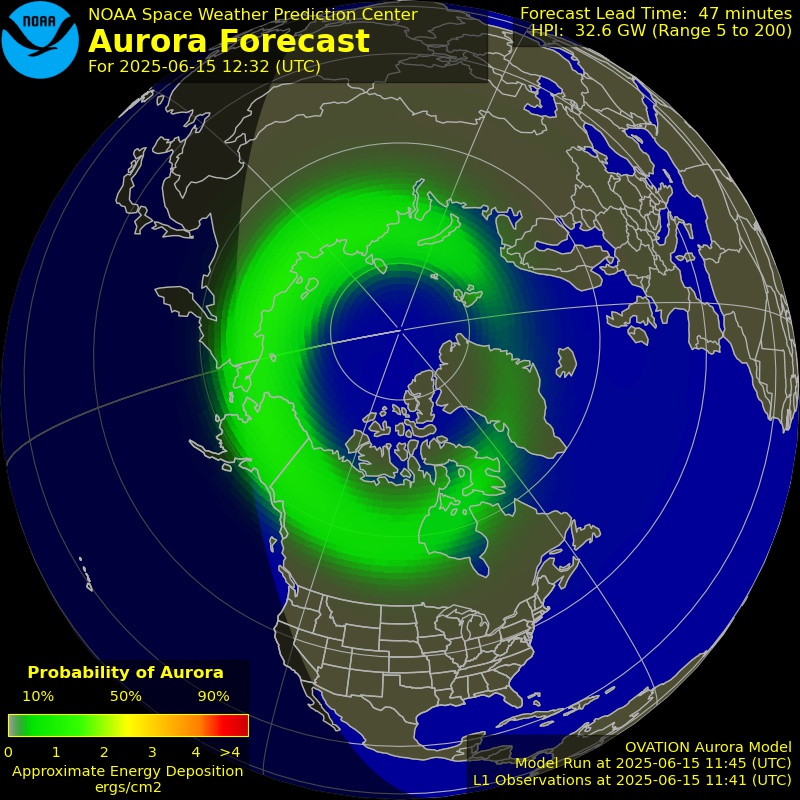
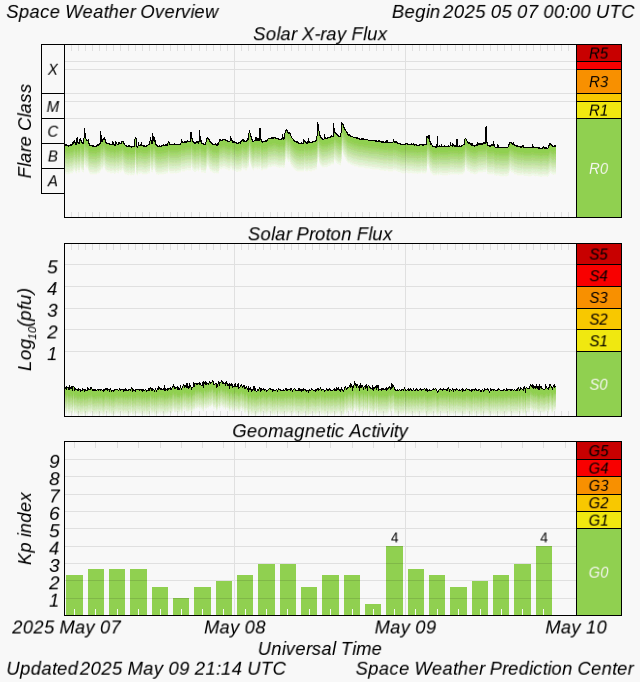
Key: Understanding Space Weather Metrics
Kp Index
What it is: The Planetary K-index (Kp) is a global measure of geomagnetic disturbance derived from ground-based magnetometers. Scale: 0-9.
How it's measured: Every 3 hours, 13 stations worldwide measure maximum magnetic field deviation, standardized and averaged.
For HF Radio: Lower is better. Kp 0-2 = Quiet. Kp 3-4 = Unsettled. Kp 5+ = Storm (HF degradation).
Fun fact: "K" is from German "Kennziffer" (characteristic number). High Kp enables VHF aurora scatter!
SFI
What it is: The Solar Flux Index (F10.7) measures solar radio emissions at 2800 MHz. Units: Solar Flux Units (sfu).
How it's measured: Daily by the Dominion Radio Astrophysical Observatory in Canada. Range: 65 (solar min) to 300+ (solar max).
For HF Radio: Higher is better. Higher SFI = more ionization = higher MUF = 10-17m bands open.
Fun fact: SFI >150 is excellent. During solar maximum, 10m can support worldwide DX with just 5 watts!
Bz (IMF)
What it is: Bz is the north-south component of the Interplanetary Magnetic Field. Units: nanotesla (nT).
How it's measured: Satellites at L1 (DSCOVR, ACE) 1 million miles from Earth measure the solar wind's magnetic field.
For HF Radio: Northward (positive) is better. Southward Bz couples with Earth's field, causing storms.
Fun fact: Bz is the "gatekeeper" - even fast solar wind is harmless if Bz stays north!
Solar Wind
What it is: Continuous stream of charged particles from the Sun's corona. Speed in km/s.
How it's measured: L1 satellites measure particle speed. Normal: 300-400 km/s. Coronal hole streams: 700-800+ km/s.
For HF Radio: Lower is better. High-speed streams can trigger disturbances when combined with -Bz.
Fun fact: Solar wind takes 2-4 days from Sun to Earth. L1 satellites give ~45 min warning!
X-Ray Flux
What it is: Measures solar X-ray emissions indicating flare activity. Classes: A, B, C, M, X (each 10× stronger).
How it's measured: GOES satellites monitor the Sun's X-ray output continuously in the 1-8 Ångström band.
For HF Radio: A/B-class is best. M/X flares cause immediate HF blackouts (SIDs) on the sunlit side.
Fun fact: The 1859 Carrington Event (~X45) made telegraph wires catch fire and auroras visible in Cuba!
Understanding the Metrics - Quick Reference
Solar Flux Index (SFI)
Measures solar radio emission at 10.7 cm wavelength. Higher is better for HF propagation. High SFI (>120) increases ionospheric ionization, raising the Maximum Usable Frequency (MUF) and enabling propagation on upper HF bands (10-17m).
Kp Index
Measures geomagnetic disturbance on a 0-9 scale. Lower is better for HF. High Kp (≥5) indicates a geomagnetic storm that can disrupt HF propagation, especially on polar/high-latitude paths. However, high Kp can enable VHF aurora propagation.
X-Ray Flux / Flares
Solar flares are classified A < B < C < M < X. M-class and X-class flares can cause sudden ionospheric disturbances (SID) that create HF radio blackouts on the sunlit side of Earth. These typically recover within 1-2 hours.
Solar Wind Speed
The speed of particles flowing from the Sun. Normal is 300-400 km/s. High-speed streams (>600 km/s) can trigger geomagnetic disturbances, especially when combined with southward Bz.
Bz (IMF Component)
The z-component of the Interplanetary Magnetic Field. Southward (negative) Bz allows efficient coupling of solar wind energy into Earth's magnetosphere, increasing geomagnetic storm probability. Northward (positive) Bz is protective.
What Makes Good Conditions?
Ideal HF DX: High SFI (>120), Low Kp (≤2), Northward or neutral Bz, No M/X-class flares. For 10m/12m: Need SFI >120 during solar cycle peaks. For 40m/80m: These bands are more forgiving of low SFI but still affected by storms.
External Resources
The Chart of Usability
At-a-glance view of all amateur bands. Bar height shows usability from 0% (unusable) to 100% (perfect conditions). Color indicates status: ● Open, ● Mostly Open, ● Variable, ● Mostly Closed, ● Closed.
Reading This Chart
This "comb" chart shows all amateur bands side-by-side. Taller bars = better conditions. Look for patterns: HF bands (left side) depend on solar conditions, while VHF/UHF bands (right side) are more stable but benefit from tropospheric enhancement. A "healthy" spectrum shows varied heights with HF following the expected solar cycle pattern.
Primary data from NOAA Space Weather Prediction Center. Additional visualizations from HamQSL/N0NBH.
Data fetched: 07/15/2026 15:00 | Auto-refresh: 07/15/2026 19:42 | Local Weather Alerts