ARPSC Fox Hunt
Radio direction finding in the field — bring your HT, sharpen your skills, and chase the fox.
Event Details
Fox Hunting 101: Finding a Hidden Transmitter with an HT (and Beyond)
A fox hunt — also known as Radio Direction Finding (RDF) or Amateur Radio Direction Finding (ARDF) — is the sport (and the emergency-comms skill) of locating a hidden transmitter using only its radio signal. It's fun on a Saturday afternoon, but it's also the exact skill set we need when a stuck microphone is keying up a repeater, an EPIRB or ELT is sounding, or an unauthorized transmitter is causing interference on a public-service frequency.
The good news: you can fox hunt with the HT already on your belt. The better news: a handful of inexpensive add-ons turn that HT into a surprisingly capable direction-finding rig.
The "Body Fade" Technique: HT Only, No Extra Gear
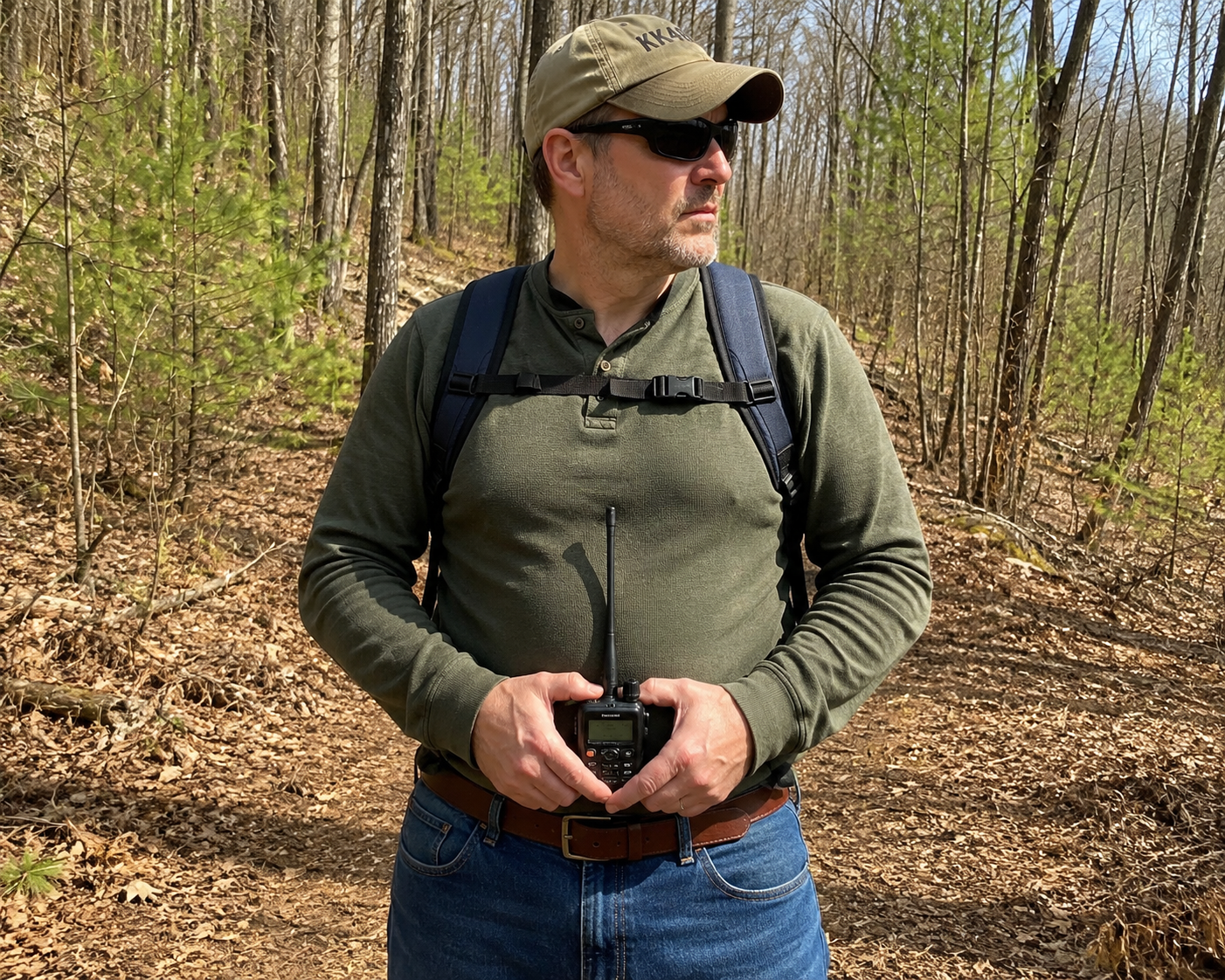
Your body is mostly water, and water is a remarkably effective RF attenuator at 2 meters and 70 cm. You can exploit that to turn yourself into a crude directional antenna.
- Tune to the fox and watch the S-meter (or signal-strength bars) on your HT.
- Hold the HT tight against your chest, antenna pointed straight up. Your torso is now blocking signal coming from behind you.
- Slowly rotate your whole body through 360°. The S-meter reading will rise and fall as you turn.
- Find the null, not the peak. The deepest dip in signal strength is where your body is blocking the fox — meaning the fox is directly behind you. Nulls are much sharper and easier to identify than peaks.
- Walk that bearing, repeat every couple hundred yards, and triangulate. As you get closer the signal will pin the meter — that's when the next trick comes in.
Make Friends with Your S-Meter
What to Watch
- S-meter bars or numeric signal strength
- Squelch break / busy indicator at low levels
- RSSI in display menus (many HTs show a number)
- How quickly the meter changes as you turn
What to Avoid
- A pegged meter — you've lost all directionality
- Multipath in tight neighborhoods (reflected signal off houses, cars, power lines)
- Trusting one bearing — always triangulate from multiple spots
- Hunting on the fox's actual frequency once you're close — switch to a nearby image or harmonic if needed
Plot It on a Map: Turning Bearings into a Location
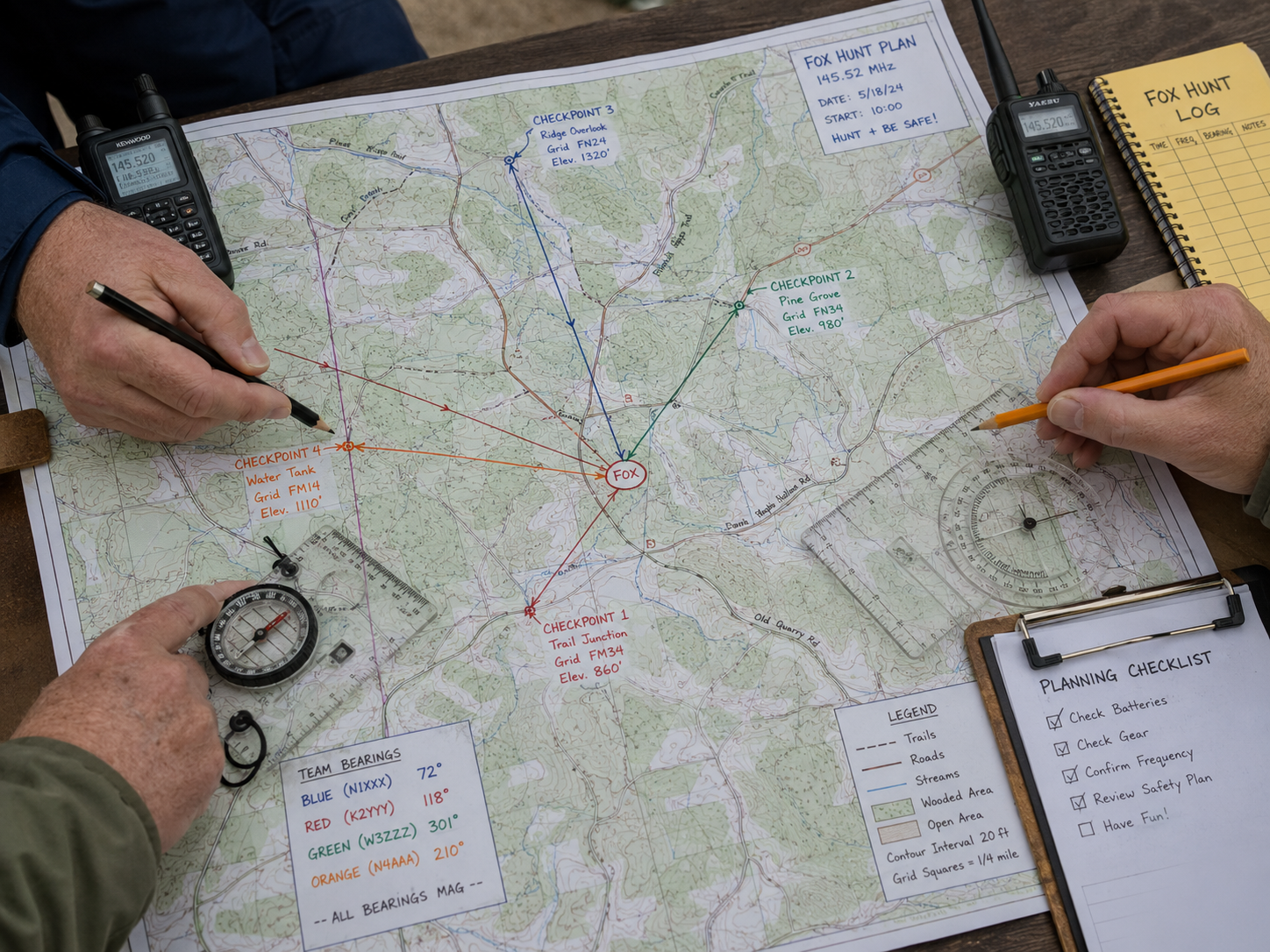
A single bearing only tells you a line — the fox is somewhere along it. Plot two or more bearings from different locations on a map and the intersection narrows the fox down to a small search area. This is triangulation, and it's the part of fox hunting that turns guesswork into a plan.
How to Plot Bearings
- Stop at a known location (trailhead, parking lot, picnic area) and find the bearing to the fox with your body-fade or Yagi.
- Mark your spot on a paper map (or drop a pin in Google Maps, Gaia GPS, or CalTopo) and draw a straight line out in the direction the fox is.
- Move a meaningful distance in a roughly perpendicular direction — not toward the fox — and take another bearing.
- Plot that line too. Where the lines cross is your best guess at the fox's location.
- Take a third bearing from a third location. Three lines rarely cross at a single point — they form a small triangle, and the fox is almost always inside it.
Reading the Map for Context
Once you have a search area, look at the map. The fox isn't usually in the middle of a pond or stuck up a tree. Foxes tend to hide where there's a logical reason to be — and the map will often tell you exactly where to start.
- Parking lots, picnic areas, public access points — favorite hiding spots for organized hunts
- High ground / hilltops — better range, often where the hunt master is set up
- Driveable side roads, cul-de-sacs — easy in and out for the fox to deploy
- Anywhere the bearings concentrate — not just the centroid, but where lines actually cross
- Hills, ridges, large buildings — can bend a bearing through reflection; expect bad bearings near them
- Lakes, rivers, open water — unlikely fox locations, but great for ruling out big chunks of map
- Tall towers, water tanks — common multipath source; double-check bearings from near them
- Power lines, substations — noise floor goes up; signal strength can be misleading
The Gear Upgrade Path
None of this is required — the body-fade trick really does work — but each of these tools makes the hunt faster, more accurate, and a lot more fun.
Directional Yagi Antenna
A handheld 2 m or 70 cm Yagi (typically 3 to 5 elements) gives you a real forward gain pattern and a strong rear null. Sweep the beam horizontally and the S-meter swings dramatically. Most hunters look for the null off the back rather than the peak off the front — nulls are sharper and more accurate.
Great for medium-range hunting and triangulating from multiple stops.
Offset / Step Attenuator
An in-line attenuator (often switchable from 0 to 60+ dB) lets you "turn down" the signal as you close in so the meter keeps reading mid-scale. An offset attenuator shifts the receive frequency so a strong fox can't get around the attenuation through the radio's case — essential for close-in work.
Pairs perfectly with a Yagi for the last mile.
Tape-Measure or Loop Antenna
A small shielded loop antenna has a very deep, very narrow null and is perfect for close-range sniffing — pinpointing a fox in a parking lot, in the woods, or inside a building. Loops are also cheap and easy to homebrew. The classic "tape-measure Yagi" is another popular DIY favorite.
Best for the final 50 feet of the hunt.
Other Useful Extras
- Headphones — hear weak signals others miss
- Compass + map (or phone GPS) for plotting bearings
- Notepad to log bearing/location pairs for triangulation
- A second radio set to the talk-around frequency for the hunt itself
- Comfortable walking shoes — foxes always seem to end up uphill
Why an ARPSC Member Should Care
Fox hunting isn't just a game. The same skills are used to locate:
- Stuck microphones that take down a repeater during an event
- Malicious or unintentional jammers on public-safety or amateur frequencies
- Downed-aircraft ELTs on 121.5 MHz (Civil Air Patrol does this constantly)
- Missing-person tracking beacons in some search-and-rescue scenarios
- RFI sources ruining your noise floor at home
What to Bring to Stony Creek
A Radio
Any dual-band HT will do. The fox alternates VHF and UHF, so a 2 m / 70 cm radio is ideal. Bring extra batteries — a long hunt is hard on power.
DF Gear (Optional)
A small Yagi, tape-measure beam, attenuator, or shielded loop makes the hunt much easier — but the body-fade trick with just an HT works surprisingly well.
Map & Notepad
Phone GPS or a paper map of Stony Creek, plus something to jot bearings on. Triangulation goes a lot faster when you can plot lines.
Headphones
Optional but helpful — you'll catch weak signals others miss, especially as you close in on the fox.
Water & Snacks
Hunts can run long. Stay hydrated — Stony Creek has plenty of trail and parking lot to cover.
Weather-Ready Clothing
Layers, walking shoes, and a hat. We're outdoors the whole time — and the fox always seems to end up uphill.
Suggested Equipment
4-Element 2 m Fox-Hunt Antenna
Lightweight handheld Yagi designed specifically for direction finding on 2 meters.
Arrow 4OFHA2 m Fox-Hunt Loop
Shielded loop antenna for the close-in portion of the hunt where a Yagi gets overloaded.
Arrow FHLDual-Band 2 m / 70 cm Yagi
The classic Arrow II hand-held — great for satellite work and fox hunting on both bands.
Arrow II 146/437Further Reading
Wikipedia: Transmitter Hunting
Background on amateur radio transmitter hunting (fox hunting / T-hunting), including techniques, equipment, and the sport's history.
Visit WikipediaHoming In (Joe Moell, KØOV)
Decades of articles, technique guides, and equipment reviews from one of the best-known voices in U.S. fox hunting.
homingin.comCivil Air Patrol ELT Searches
How CAP uses VHF direction finding to locate downed-aircraft emergency locator transmitters — the same techniques we use on the repeater.
CAP Emergency ServicesWikipedia: Amateur Radio Direction Finding
The competitive, on-foot side of the hobby (ARDF) — international rules, classes, equipment, and how organized hunts are run.
Visit WikipediaBottom Line
You don't need expensive gear to fox hunt — just an HT with an S-meter, a little patience, and your own body as the attenuator. Add a Yagi, an offset attenuator, and a loop over time and you'll be the one we call when a stuck mic is holding the repeater hostage.
Frequencies Coming Soon
The fox transmit frequencies for VHF and UHF will be announced shortly before the event — and will also be confirmed on the day of the hunt. Watch our Events page, the weekly net, and the ARPSC Discord for updates.